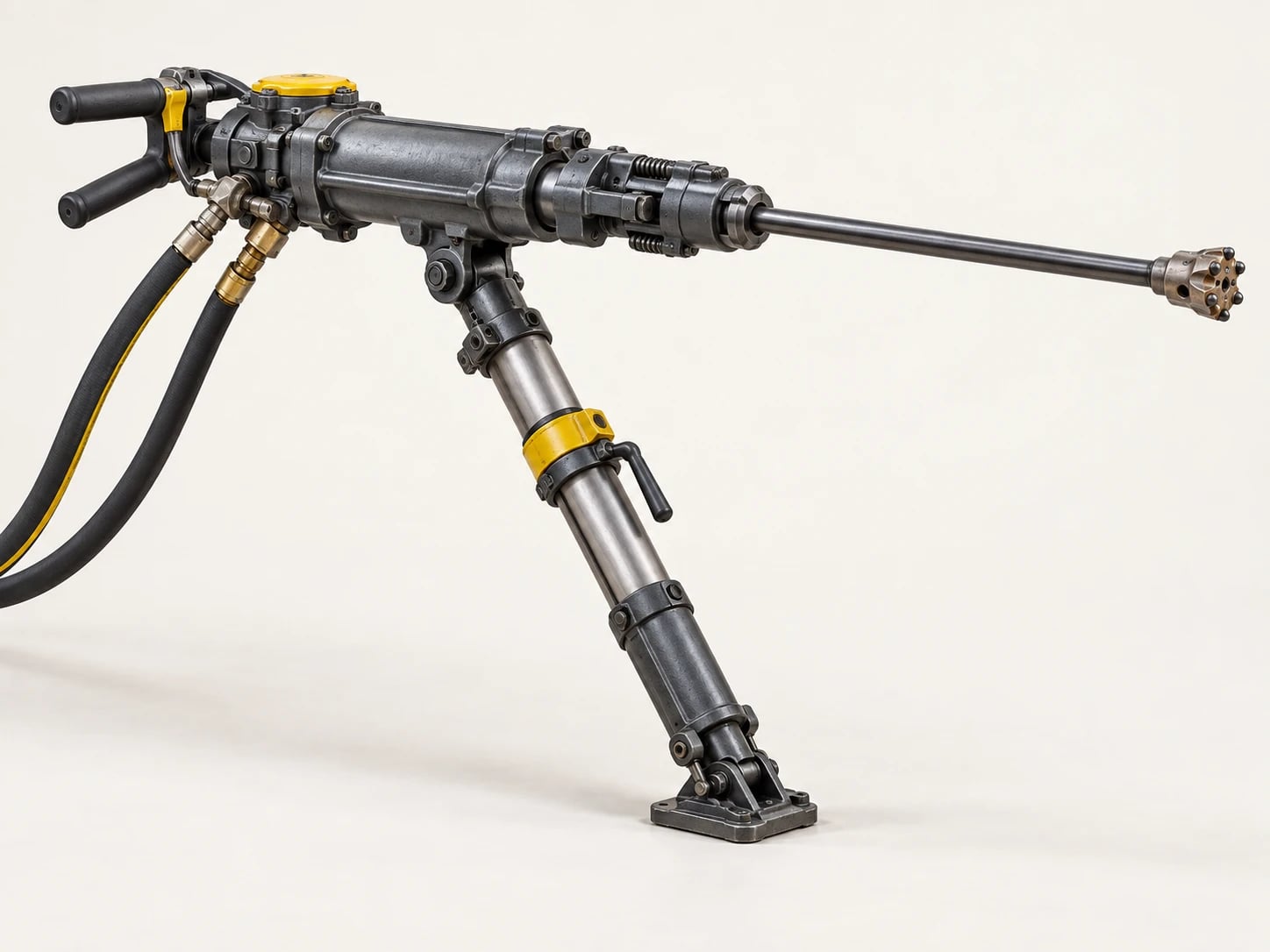
Electric or Pneumatic Rock Drills: Comparing Running Cost
Most small underground mines in Tanzania drill with pneumatic jacklegs, and the drill itself is rarely the expensive part. The cost sits in the compressed air. Turning diesel or electricity into compressed air and sending it down a long pipe loses a large share of the energy, so an operation that runs several drills pays mainly for its compressor and its leaks. Electric and hydraulic handheld drills avoid that conversion, which is why operators ask whether they would be cheaper to run.
The air demand shows the scale. A jackleg needs about 100–150 cfm at 6–7 bar, and four drills working together need about 500–600 cfm once leakage and simultaneous use are included. A compressor typically needs roughly 0.12–0.15 kW for each cfm at 7 bar, so that duty takes about 60–90 kW of compressor power. On a system that has never been checked for leaks, 20–30% of that output can be lost before it reaches the face.
| Pneumatic jackleg | Electric or hydraulic handheld drill | |
|---|---|---|
| Energy route | Fuel or grid → compressor → air line → drill | Grid or generator → cable → drill (or power pack) |
| Main running cost | Compressor fuel or power, leaks, air-line oil | Electricity, cables, drill servicing |
| Strengths | Simple, robust, widely known and repaired locally | Avoids compressor losses; quieter at the face on some models |
| Limits | Inefficient energy use; noise; depends on a well-sized compressor | Needs safe power at the face, suitable ratings for wet or gassy conditions, local parts and trained repairers |
For most small mines, the quickest saving is not a new drill type but a better air system: fix leaks, keep pipe losses low and match the compressor to the drills actually in use. An electric drill becomes worth a trial where reliable power can be brought safely to the face, the mine plans to drill for years rather than months and a supplier can support the machine locally. Compare the two on the same basis: energy cost per metre drilled, maintenance, downtime and the training the crew needs, measured on a trial rather than taken from a brochure.
Pneumatic Rock Drill (Jackleg) Specifications
The figures below describe typical industry specifications for this class of equipment rather than a single fixed model. Use them to scope a requirement, then confirm exact figures against the supplied unit before purchase.
| Specification | Typical value |
|---|---|
| Hole diameter | 32–45 mm typical |
| Hole depth per steel | 0.8–3.2 m in 0.8 m increments |
| Air consumption | 100–150 cfm (2.8–4.2 m³/min) at 6–7 bar |
| Steel | Hex 22 mm or 25 mm, integral or tapered |
| Bit | Carbide chisel or button, 34–41 mm |
| Mass | 25–45 kg plus pusher leg |
| Lubrication | Inline air-line oiler, mandatory |
| Water | Front-head water flushing to suppress dust |
| Noise | 110–120 dB(A) at the operator; hearing protection mandatory |
Pneumatic Rock Drill (Jackleg): Uses and Applications
- Development blasting rounds in small shafts and drives
- Production drilling on narrow veins
- Secondary blasting of oversize
- Anchor and utility holes underground
Maintenance Schedule
Most premature failures in this equipment class trace back to a missed routine check rather than a design fault. The intervals below are a practical starting schedule; adjust them to your duty cycle and the manufacturer manual.
| Interval | Task |
|---|---|
| Every shift | Fill the air-line oiler; inspect hoses, water tube and steel threads; check the leg for smooth travel. |
| Daily | Flush the drill with oil at knock-off; inspect chuck bush and rotation pawls. |
| Weekly | Strip front head if rotation is sticky; inspect rifle bar and piston. |
| On failure to rotate or hammer | Usually dry running (no oiler) or worn chuck. Do not keep running a dry drill — it seizes. |
Frequently Asked Questions
How much compressor do four jacklegs need?
100–150 cfm each, plus leakage and diversity. Four drills working together need about 500–600 cfm at 6–7 bar at the face, not 400. Undersized air is the usual reason penetration drops and steels stick. See the mining air compressor page for the other half of this specification.
Jackleg, stoper or sinker?
Jackleg (pusher-leg) for drifting and inclined holes. Stoper (uphole) for raising and roof holes. Sinker for downward holes in shafts. They are different machines; a jackleg used as a stoper wrecks the miner and the hole. Specify the duty.
Why is water flushing mandatory?
Because dry drilling in silica ore produces respirable crystalline silica, which causes silicosis. Water through the steel knocks the dust down at the hole. Dry drilling is still seen on Tanzanian small mines and is one of the most damaging shortcuts in the industry.
Supply and Delivery Across Tanzania
Bart Mining supplies pneumatic rock drill (jackleg) and related equipment to mining operations throughout Tanzania, with primary coverage of the Lake Victoria Goldfields (Mwanza, Kahama, Geita, Shinyanga and Bukombe), alongside the Lupa Goldfields around Chunya and Mbeya, and delivery nationwide from Dar es Salaam.
Manufacturer or supplier of this equipment? Bart Mining sells machinery like the pneumatic rock drill (jackleg) to buyers across Tanzania through its local market partnership.