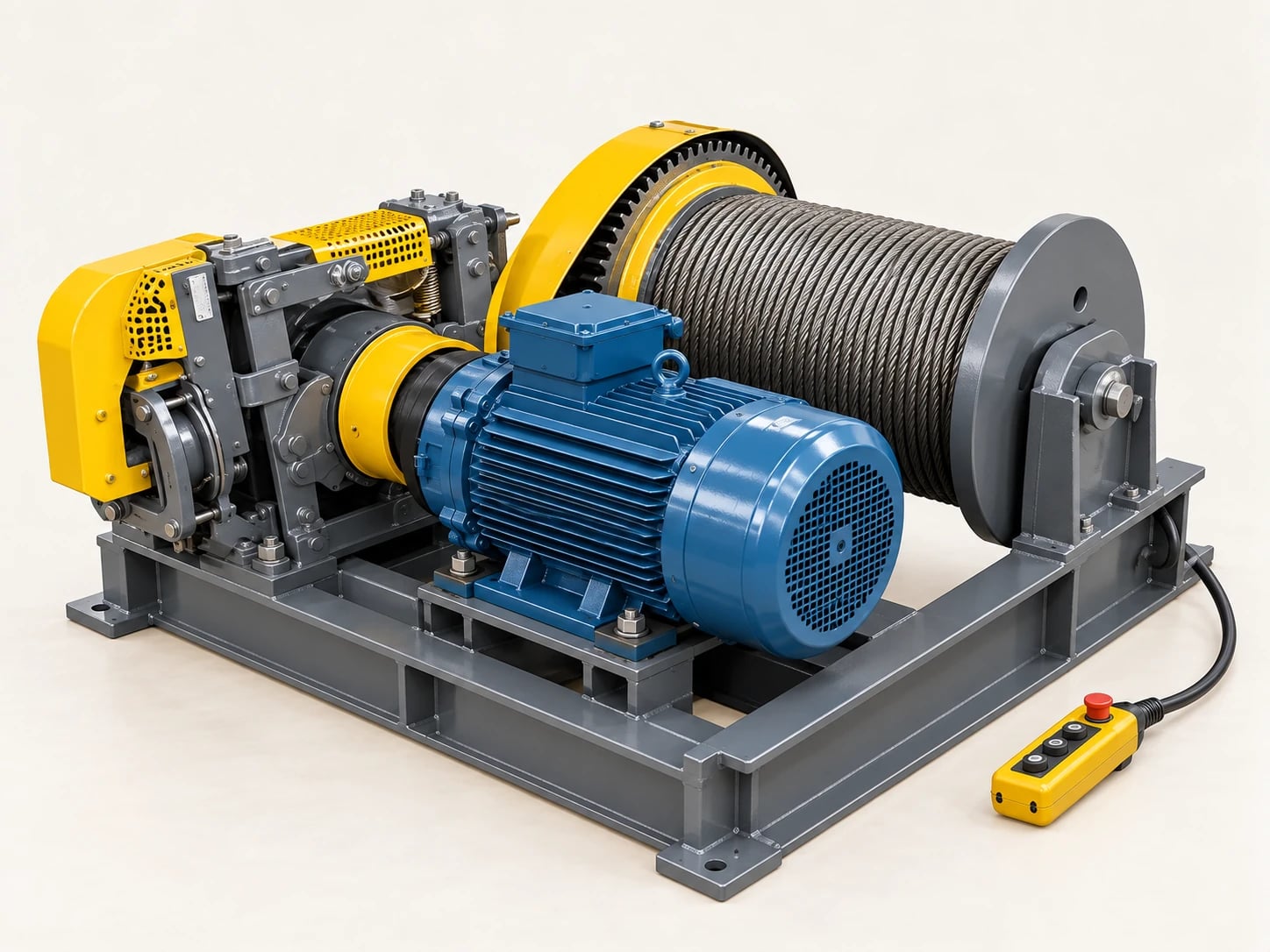
Choosing Between a 1, 2 and 5 Tonne Winch
The right winch depends on the heaviest load it will lift, how deep the shaft is and whether it serves a temporary job or permanent production hoisting. Rated line pull is quoted on the first rope layer. As rope builds up on the drum, the available pull falls, so a winch working near its rating on a deep shaft can struggle when the drum is nearly full. The table compares the three sizes we describe, using the figures on each product page.
| 1 tonne | 2 tonne | 5 tonne | |
|---|---|---|---|
| Rated line pull (first layer) | 1,000 kg | 2,000 kg | 5,000 kg |
| Typical shaft depth | Up to about 60 m | About 60–120 m | About 120–300 m |
| Wire rope diameter | 8–11 mm | 11–14 mm | 16–20 mm |
| Drum rope capacity | 30–120 m | 60–200 m | 150–400 m |
| Line speed | 8–15 m/min | 7–12 m/min | 15–45 m/min |
| Motor | 1.5–3.0 kW | 3.0–5.5 kW | 7.5–15 kW |
| Machine mass | 60–130 kg | 180–350 kg | 900–2,500 kg |
| Typical role | Ore buckets on shallow shafts, hauling and positioning | Deeper shafts, larger buckets, skips on inclines | Permanent production hoisting with skips or kibbles |
To choose, add up everything hanging on the rope at its heaviest moment: the bucket or kibble, the ore inside it and the rope itself between the drum and the bottom of the shaft. The rope supplier gives its mass per metre, and on a deep shaft that weight is significant. Then allow a margin so the winch is not working at its limit on every lift.
As a worked assumption, suppose a kibble weighs 250 kg empty and carries 600 kg of ore. That is 850 kg before the rope is counted. A 1 tonne winch would leave very little margin once the rope is added, especially with the drum nearly full, so a 2 tonne winch is the safer choice for that duty. Replace these figures with your actual bucket weight, fill and shaft depth.
Depth also matters beyond load. A deeper shaft needs more rope on the drum, and a production shaft that hoists all day needs the line speed, braking and inspection regime of a permanent installation rather than a portable winch. Any winch that carries people must be designed, certified and inspected for that purpose, with a much higher rope safety factor than goods hoisting. Confirm the current requirements for your licence with the Mining Commission and OSHA Tanzania before commissioning. For a quotation, send us the shaft depth, the heaviest load including the bucket, how many hours a day it will run and your power supply.
1 Tonne Electric Winch Specifications
The figures below describe typical industry specifications for this class of equipment rather than a single fixed model. Use them to scope a requirement, then confirm exact figures against the supplied unit before purchase.
| Specification | Typical value |
|---|---|
| Rated line pull (first layer) | 1,000 kg (1 tonne) |
| Wire rope diameter | 8–11 mm, 6×19 or 6×37 IWRC |
| Drum rope capacity | 30–120 m depending on drum width |
| Line speed (first layer) | 8–15 m/min |
| Motor rating | 1.5–3.0 kW |
| Power supply | 400 V 3-phase 50 Hz, or 230 V 1-phase |
| Duty cycle | S3, 25–40% ED |
| Brake | Fail-safe electromagnetic disc, ≥125% rated load |
| Ingress protection | IP54–IP55 |
| Ambient operating range | −10 °C to +40 °C |
| Machine mass | 60–130 kg |
| Mounting | Floor, wall or portable skid frame |
1 Tonne Electric Winch: Uses and Applications
- Raising ore buckets from shafts to ~60 m
- Hauling equipment up decline ramps
- Positioning pumps and compressors underground
- Vehicle recovery on haul roads
- Loading and unloading plant components
Maintenance Schedule
Most premature failures in this equipment class trace back to a missed routine check rather than a design fault. The intervals below are a practical starting schedule; adjust them to your duty cycle and the manufacturer manual.
| Interval | Task |
|---|---|
| Every shift | Visual rope check for broken wires, kinks, birdcaging and corrosion; confirm brake holds a stationary load. |
| Weekly | Lubricate wire rope; check drum anchorage and that at least three dead turns remain on the drum at full payout. |
| Monthly | Inspect gearbox oil level; check motor mounting bolts, coupling alignment and cable glands. |
| Quarterly | Measure brake lining thickness and reset air gap; test overload protection and emergency stop. |
| Annually | Full load test to 125% rated capacity with certification; replace rope if broken wires exceed the discard criteria in ISO 4309. |
Frequently Asked Questions
How much can a 1 ton winch actually lift?
The 1,000 kg rating applies to the first layer of rope on the drum. Each additional layer increases the effective drum radius and reduces available pull by roughly 10–15%, so a winch fully wound to a fourth layer may only deliver 650–750 kg. Always size on the outer-layer figure if the rope will be substantially wound out.
What size wire rope does a 1 tonne winch use?
Typically 8–11 mm diameter in 6×19 or 6×37 independent wire rope core construction. The rope must be selected with a minimum breaking load giving at least 5:1 safety factor against the rated line pull, and 8:1 where the winch lifts personnel, which most goods winches are not certified to do.
Can a 1 ton winch be used to raise people from a shaft?
No, not unless it is specifically certified as a man-riding winch. Goods-rated winches lack the redundant braking, overspeed governor and higher rope safety factor required for personnel hoisting. Using one to raise workers is a common and serious cause of fatalities in small-scale mining.
Will a 1 tonne electric winch run on Tanzanian mains power?
Yes. Tanzania supplies 230 V single phase and 400 V three phase at 50 Hz, and both single-phase and three-phase 1 tonne winches are available for those ratings. Confirm the motor nameplate reads 50 Hz. A 60 Hz motor run at 50 Hz loses roughly 17% of its speed and can overheat under continuous load.
What is the difference between line pull and lifting capacity?
Line pull is the horizontal force the winch can exert, which is what most ratings quote. Vertical lifting capacity is lower because the load is carried entirely by the rope and brake with no ground friction assisting. For vertical shaft duty, derate a horizontal-rated winch or specify a hoist rated for lifting.
How long does a wire rope last on a shaft winch?
In continuous ore-raising duty, expect 6–18 months depending on drum diameter ratio, sheave condition, lubrication and abrasive loading. Ropes must be discarded on the criteria in ISO 4309: broken wires per lay length, diameter reduction, corrosion or core damage. Age alone is not a criterion.
Supply and Delivery Across Tanzania
Bart Mining supplies 1 tonne electric winch and related equipment to mining operations throughout Tanzania, with primary coverage of the Lake Victoria Goldfields (Mwanza, Kahama, Geita, Shinyanga and Bukombe), alongside the Lupa Goldfields around Chunya and Mbeya, and delivery nationwide from Dar es Salaam.
Commonly supplied to: Mwanza, Shinyanga, Nzega and Igunga.
Manufacturer or supplier of this equipment? Bart Mining sells machinery like the 1 tonne electric winch to buyers across Tanzania through its local market partnership.