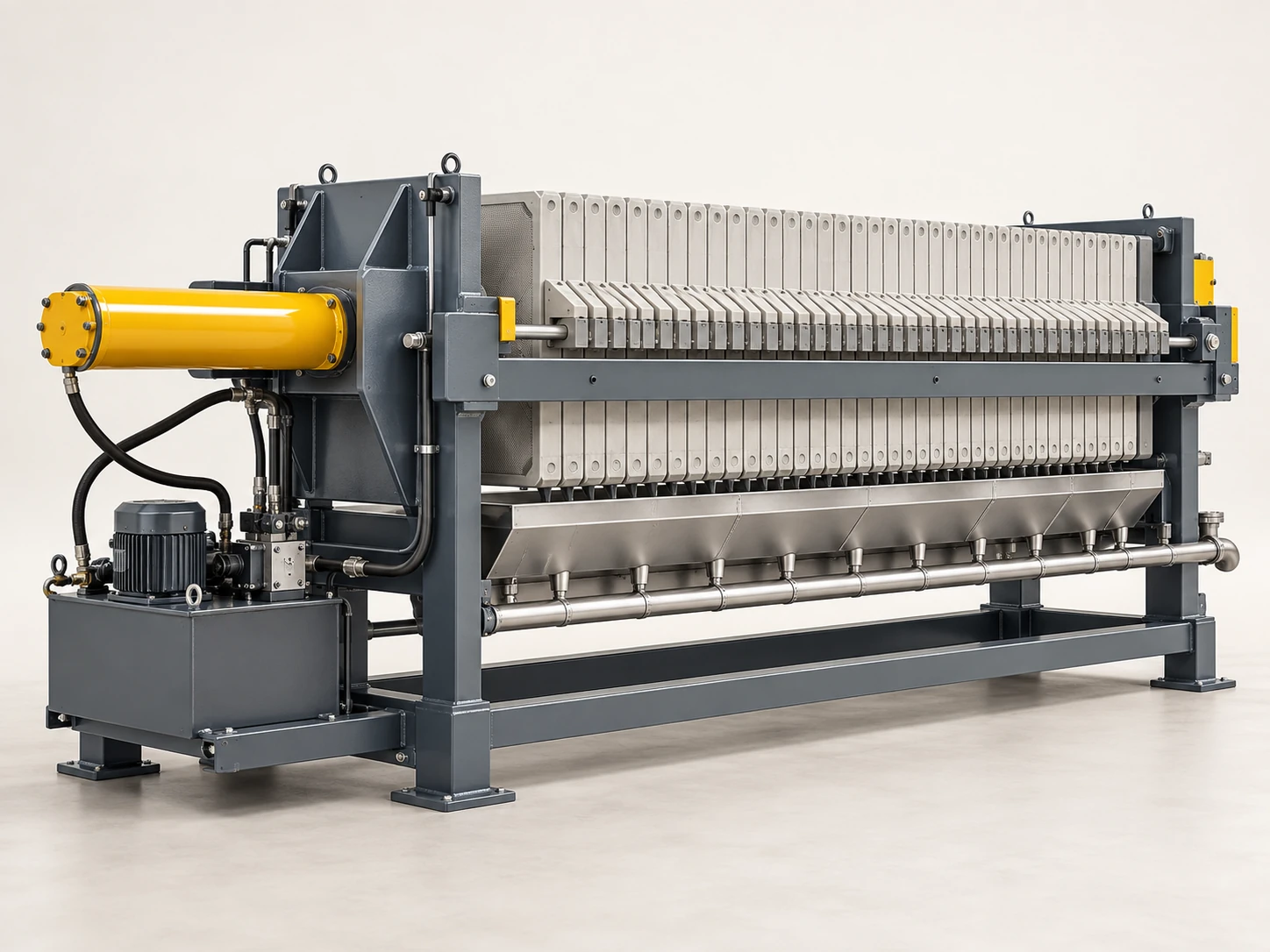
Filter Presses and Dry-Stacked Tailings
Most small gold plants send tailings to a wet pond, where the solids settle and the water is reused or evaporates. Dry stacking takes a different route: a filter press removes most of the water first, and the damp cake is stacked and compacted on a prepared area. The plant recovers more water for reuse and avoids holding a large volume of slurry behind an embankment.
Dry stacking suits sites where water is scarce, where there is little room or poor ground for a pond, or where the operator wants to reduce the risk that comes with storing liquid tailings. It costs more to build and run than a simple pond, because the press, its pump, cloths and power must operate every day, and the stack still needs drainage, compaction and control of rain runoff. In Tanzania, tailings management is approved through the project’s environmental impact assessment and plans, so discuss the option with your environmental consultant and NEMC early rather than after the plant is designed.
Sizing a Filter Press for Tailings: A Worked Example
A press is sized from the dry solids it must handle each day, the cake moisture it can reach and its cycle time. The example below uses assumed figures to show the order of the calculation; a filtration test on your actual tailings sets the real cycle time and moisture.
- Solids. Assume the plant produces 50 tonnes of dry tailings solids per day.
- Cake. At an assumed 15% cake moisture, the press produces about 50 ÷ 0.85 = 59 tonnes of wet cake per day.
- Water recovered. If the tailings slurry is an assumed 40% solids by mass, it carries 75 m³ of water a day. The cake keeps about 9 m³, so the press returns roughly 66 m³ a day to the process.
- Cycles. With an assumed 60-minute filtration cycle plus 20 minutes to open, discharge and close, a press running 20 hours completes about 15 cycles a day.
- Volume per cycle. Each cycle must hold about 59 ÷ 15 = 3.9 tonnes of cake. At an assumed cake density of 1.9 t/m³, that is about 2 m³ of chamber volume, which the supplier converts into a plate size and number of plates.
The same steps apply to concentrate or elution residues on a much smaller scale. For a quotation, send the dry tonnes per day, the slurry density, a particle-size result for the tailings and the hours the press will run, and ask the supplier to confirm cycle time and cake moisture from a filtration test before you commit.
Filter Press Specifications
The figures below describe typical industry specifications for this class of equipment rather than a single fixed model. Use them to scope a requirement, then confirm exact figures against the supplied unit before purchase.
| Specification | Typical value |
|---|---|
| Plate size | 630, 800, 1,000, 1,250, 1,500 mm |
| Type | Chamber or membrane (squeezing) plates |
| Operating pressure | 8–16 bar feed; up to 15 bar squeeze on membrane |
| Cake moisture | 12–20% typical on gold tailings and concentrate |
| Cycle time | 20–90 min depending on feed and cloth |
| Cloth | Polypropylene, chosen for particle size and chemistry |
| Automation | Manual, semi-auto or full plate-shift |
| Feed | Positive-displacement pump, pressure-limited |
Filter Press: Uses and Applications
- Dry-stack tailings
- Concentrate dewatering before smelting or sale
- Elution and electrowinning residues
- Process-water recovery on water-constrained sites
Maintenance Schedule
Most premature failures in this equipment class trace back to a missed routine check rather than a design fault. The intervals below are a practical starting schedule; adjust them to your duty cycle and the manufacturer manual.
| Interval | Task |
|---|---|
| Every cycle | Inspect cloths for tears and blinding; confirm all chambers filled and the drip trays are clear. |
| Daily | Wash cloths; check hydraulic closing pressure; inspect plate handles and cloth clips. |
| Weekly | Inspect plates for cracking or warping; check feed-pump seals. |
| Monthly | Hydraulic oil and hoses; replace any weeping cloths as a set in that zone. |
| Annually | Plate-pack inspection; hydraulic-cylinder service; cloth-inventory review. |
Frequently Asked Questions
When is a filter press justified on a small gold plant?
When water is scarce, when a wet tailings dam cannot be permitted, or when concentrate must travel. Water recovery alone can justify a press in dry Tanzanian districts. Below a few tens of tonnes a day of tailings, a simple settling pond still wins on cost if the ground and the permit allow it.
Chamber or membrane plates?
Chamber plates are cheaper and fine on free-filtering concentrate. Membrane plates squeeze the cake after filling and cut moisture by several percent, which matters on tailings that must be stacked or trucked. The extra capital is usually recovered in drier cake and shorter cycles on tailings duty.
Why is my cake still wet?
Cloth blinding, feed too fine or too dense, short cycle, or a leaking plate that bypasses pressure. Do not just raise feed pressure — that packs the cloth. Wash or replace cloths, check for bypass, and confirm the feed particle size has not drifted finer after a mill change.
Supply and Delivery Across Tanzania
Bart Mining supplies filter press and related equipment to mining operations throughout Tanzania, with primary coverage of the Lake Victoria Goldfields (Mwanza, Kahama, Geita, Shinyanga and Bukombe), alongside the Lupa Goldfields around Chunya and Mbeya, and delivery nationwide from Dar es Salaam.
Manufacturer or supplier of this equipment? Bart Mining sells machinery like the filter press to buyers across Tanzania through its local market partnership.