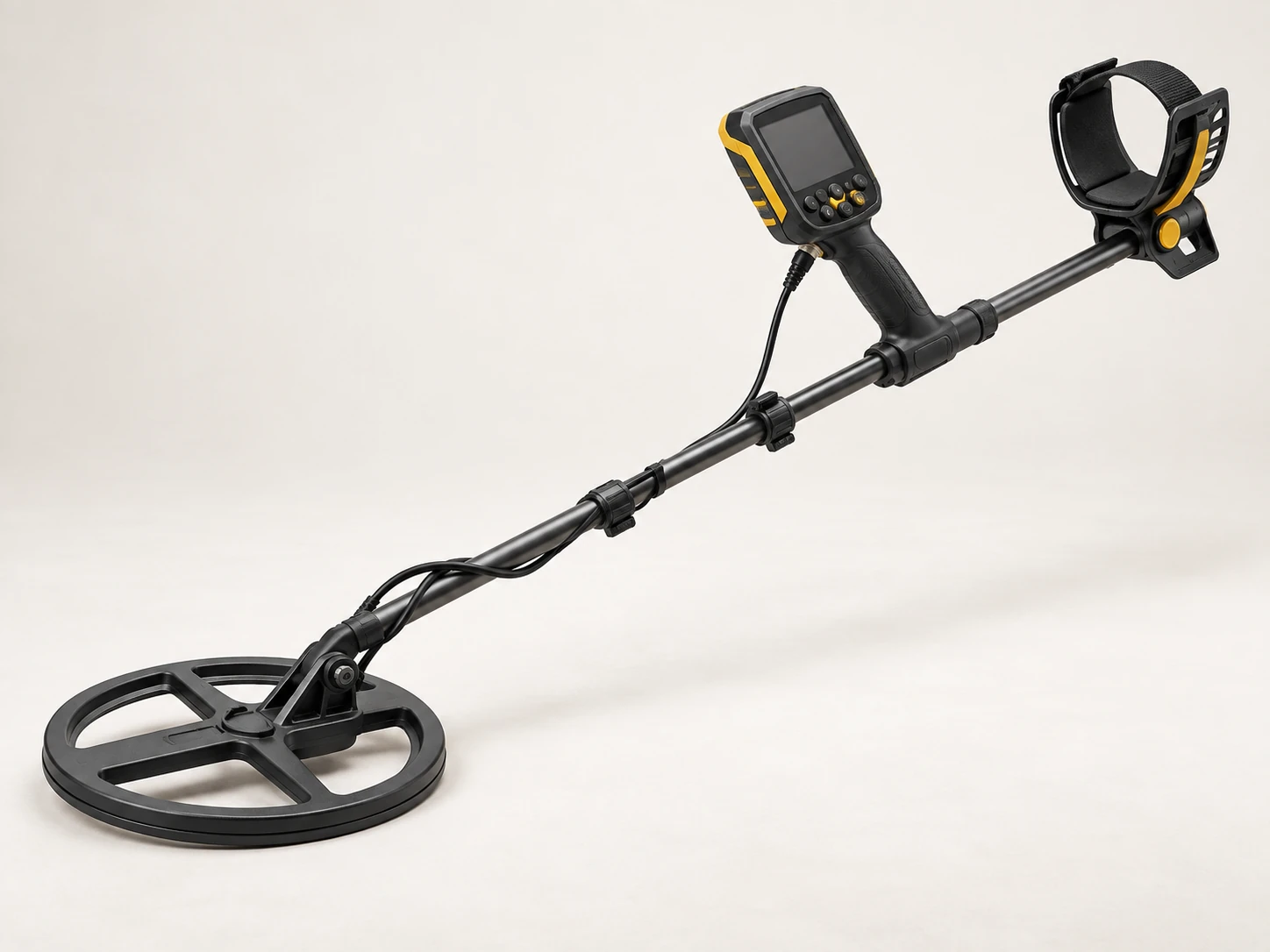
PI vs VLF Gold Detectors: How They Differ
Both kinds of detector send a magnetic field into the ground and listen for the response from metal. They differ in how they do it, and that decides how they cope with mineralised soil.
- VLF (very low frequency) detectors transmit a continuous signal, typically 18–71 kHz on gold machines, and measure the phase shift of the return. Higher frequencies are more sensitive to small gold. VLF can discriminate, telling gold from iron trash, but iron-rich soil also produces a strong signal, so depth and stability fall in laterite.
- PI (pulse induction) detectors send short, powerful pulses and listen to the decaying echo after each one. Mineralised ground's signal fades quickly while metal's lingers, so a PI largely ignores the ground. The trade-off is weak discrimination: a PI finds every nail and bullet, and is heavier and more expensive.
- Multi-frequency VLF detectors transmit several frequencies at once, recovering some of the ground tolerance of PI while keeping discrimination. They are a practical all-rounder on moderately mineralised ground.
| VLF | Pulse induction (PI) | |
|---|---|---|
| How it works | Continuous signal, 18–71 kHz, phase measurement | Short pulses, measures signal decay after each pulse |
| Mineralised ground (laterite, ironstone) | Loses depth, noisy, needs constant ground balancing | Stable; largely ignores mineralisation |
| Depth on larger nuggets | Moderate | Deepest, up to 1 m or more with a large coil |
| Very small gold near surface | Excellent on high-frequency machines | Good with short pulse delay and small coil, weaker than high-frequency VLF |
| Discrimination (rejecting trash) | Yes | Minimal; dig most signals |
| Hot rocks | Frequent false signals | Far fewer |
| Weight and battery | Lighter, longer battery life | Heavier, higher power draw |
| Cost | Lower | Higher |
| Best fit | Mild soil, small shallow gold, trashy old camps | Mineralised goldfields, deeper nuggets, most Tanzanian ground |
Which Gold Detector for Which Job
| Job | Detector type and set-up |
|---|---|
| Nugget hunting on red laterite and ironstone (Geita, Mwanza, Shinyanga) | PI with a mono or double-D coil; ground balance on the actual soil before starting |
| Deep nuggets on old eluvial ground | PI with a large coil (35–45 cm); slower sweep, more digging |
| Very small gold in mild soil or shallow gullies | High-frequency VLF (around 40–71 kHz) with a small concentric or DD coil |
| Old workings and camps full of iron trash | VLF or multi-frequency, using discrimination to skip trash |
| Checking dumps, tailings and ore on a sorting table | Small-coil VLF or pinpointer; big PI coils overload on dense metal-rich material |
| Tracing a gold trail to the reef | PI on the slope, logging each find by GPS; see technique below |
A detector recovers coarse, free gold only. Fine gold in gravel or crushed ore needs gravity equipment such as a shaking table or centrifugal concentrator.
Coils, Ground Balance and Field Technique
Choosing a coil
- Double-D (DD) coils handle mineralised ground better and give a narrow, predictable detection pattern. They are the default on most Tanzanian ground.
- Mono coils on a PI give maximum depth and sensitivity, but are noisier in heavy mineralisation.
- Coil size trades depth for small-gold sensitivity: 15–25 cm coils for small gold and trashy ground, 35–45 cm for depth on larger nuggets and open ground.
Ground balance and hot rocks
Ground balance tells the detector what the soil sounds like so it can ignore it. Balance at the start of every new patch of ground, and re-balance when the soil colour changes. Ironstone and magnetite pebbles ("hot rocks") still give signals. Learn their sound by passing the coil over a known hot rock before hunting.
Technique that finds more gold
- Sweep slowly and overlap each pass by about half a coil width, keeping the coil flat and close to the ground.
- Dig every repeatable signal on a PI. Small and deep gold often gives the faintest response.
- Check the hole and the spoil separately to confirm where the target is before digging further.
- Log every nugget with GPS and depth. Clusters and lines of finds point to where the gold came from.
- Work upslope from clusters. Eluvial gold sheds downhill from its source, so the trail narrows towards the reef, which then needs proper exploration such as trenching or RC drilling.
Buying a Gold Detector in Tanzania: Checklist
- Match the machine to your ground. Test on your own soil with a known small gold target, or ask the supplier to demonstrate on similar laterite, before paying.
- Buy genuine. Copies of well-known detectors circulate in the region. Check the serial number with the manufacturer and insist on a written warranty.
- Warranty and repairs. Ask where the unit is serviced and how long a repair takes. A detector away for months is a lost season.
- Spare coil and cover. Coils crack on rocky ground. A spare coil cover is cheap; a spare coil keeps you working.
- Power off grid. Plan batteries and charging: spare battery packs and a solar or vehicle charger for multi-day trips.
- Headphones and pinpointer. Good headphones reveal faint deep signals; a handheld pinpointer halves digging time.
- Training. Ground balancing and signal reading take practice. Budget time for it before judging a detector.
Prices vary widely by type, coil and whether the unit is genuine. Tell us your ground, the gold you are chasing and your budget on WhatsApp, and we will recommend a detector type and quote.
Gold Prospecting Metal Detector Specifications
The figures below describe typical industry specifications for this class of equipment rather than a single fixed model. Use them to scope a requirement, then confirm exact figures against the supplied unit before purchase.
| Specification | Typical value |
|---|---|
| VLF frequency range | 18–71 kHz for gold-specific machines |
| PI pulse delay | 5–25 µs; shorter delay finds smaller gold |
| Detection depth, small nugget | 5–25 cm depending on size and soil |
| Detection depth, large nugget | Up to 1 m or more on PI machines |
| Ground balance | Automatic tracking or manual; essential in laterite |
| Discrimination | Available on VLF; minimal on PI by design |
| Coil types | Concentric, double-D, mono; 15–45 cm diameter |
| Waterproofing | Coil submersible; control box weather resistant |
| Battery life | 8–20 hours |
| Mass | 1.2–2.5 kg |
| Best soil conditions | PI strongly preferred in mineralised laterite |
Gold Prospecting Metal Detector: Uses and Applications
- Artisanal and small-scale nugget prospecting
- Following eluvial gold trails to a hard-rock source
- Checking tailings and old workings
- Rapid field reconnaissance of a new licence
- Locating buried metal infrastructure on site
Maintenance Schedule
Most premature failures in this equipment class trace back to a missed routine check rather than a design fault. The intervals below are a practical starting schedule; adjust them to your duty cycle and the manufacturer manual.
| Interval | Task |
|---|---|
| Every use | Ground balance at the start of each new area; check coil cable is wound and secured to the shaft. |
| Daily | Clean the coil cover and inspect for cracks; dry the control box before storage. |
| Weekly | Inspect connector pins for corrosion; check headphone lead and battery contacts. |
| Monthly | Replace worn coil covers and shaft locking collars; verify performance against a buried test target. |
Frequently Asked Questions
VLF or pulse induction for Tanzanian conditions?
Pulse induction, in most cases. The lateritic and iron-rich soils across the Lake Victoria Goldfields are heavily mineralised, and VLF machines lose depth and stability in that ground. VLF still wins for very small near-surface gold in mild soil and where trash discrimination matters.
How deep will a gold detector find a nugget?
Depth scales with target size, not detector price alone. A one-gram nugget may be detectable at 10–20 cm; a several-hundred-gram nugget can be found at a metre or more with a PI machine and a large coil. Soil mineralisation reduces all these figures.
Can a metal detector find a gold reef or vein?
Not directly. Detectors respond to metallic gold, not to gold locked in sulphides or fine gold in quartz. Their exploration value is in tracing eluvial nuggets uphill to the hard-rock source, which is a legitimate and frequently productive targeting technique.
Do I need a licence to prospect with a detector in Tanzania?
Prospecting for minerals requires the appropriate licence from the Mining Commission, and detecting on someone else's licence area or on protected land is an offence. Detector ownership is not the issue; the right to prospect a given piece of ground is. Confirm licence status before working an area.
Supply and Delivery Across Tanzania
Bart Mining supplies gold prospecting metal detector and related equipment to mining operations throughout Tanzania, with primary coverage of the Lake Victoria Goldfields (Mwanza, Kahama, Geita, Shinyanga and Bukombe), alongside the Lupa Goldfields around Chunya and Mbeya, and delivery nationwide from Dar es Salaam.
Manufacturer or supplier of this equipment? Bart Mining sells machinery like the gold prospecting metal detector to buyers across Tanzania through its local market partnership.
Safety and scope references: Mining Commission licence services