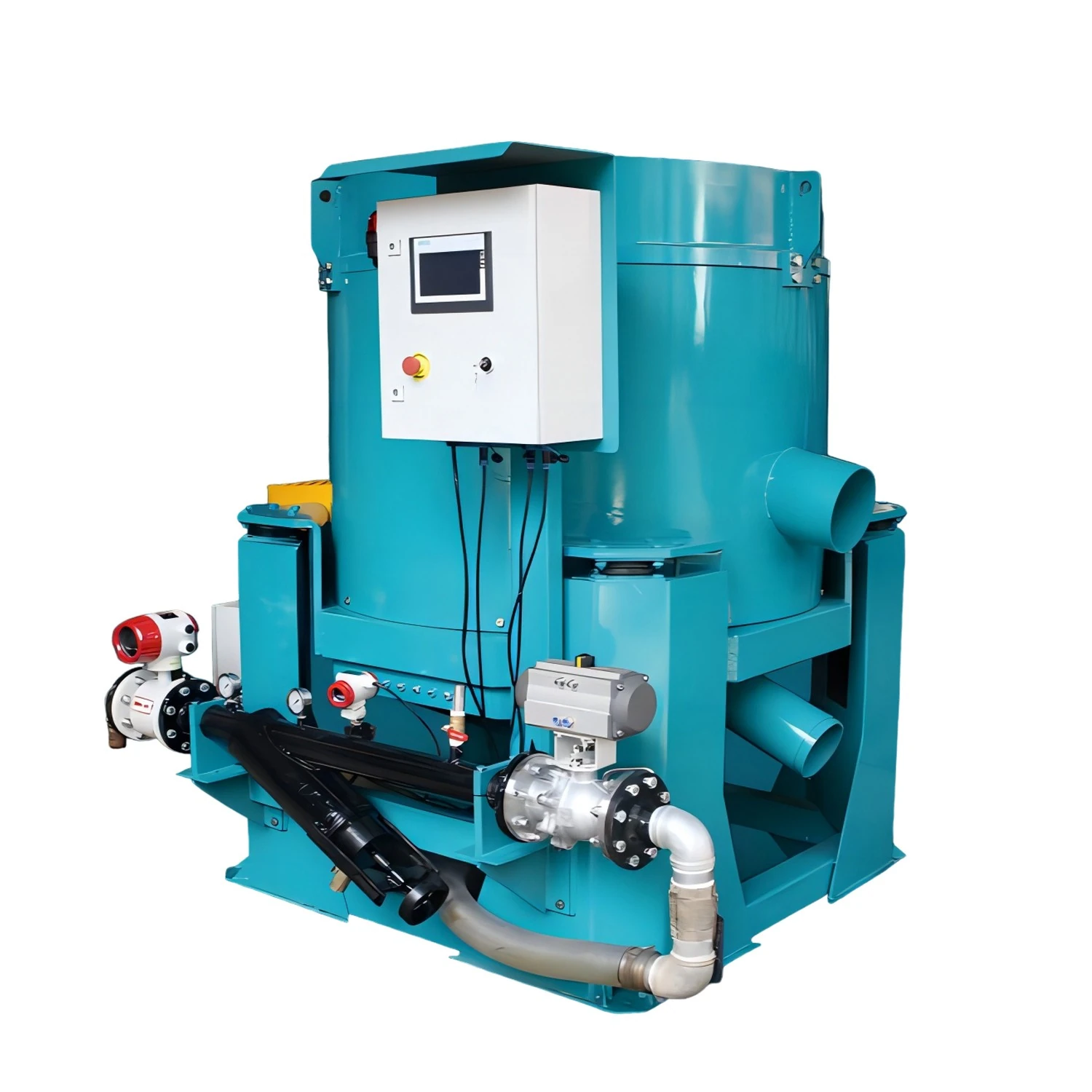
How a Centrifugal Gold Concentrator Works
Gold is roughly seven times denser than the quartz and silicate rock around it. Under ordinary gravity, a fine gold particle settles too slowly to separate cleanly from the slurry. A centrifugal concentrator multiplies the effective gravity 60–200 times, so even fine gold separates by density in seconds.
- Feed. Screened slurry (usually below 2 mm) enters through a central pipe and reaches the base of the spinning bowl.
- Stratification. Centrifugal force drives the slurry outwards and up the bowl wall. Dense particles, gold and heavy minerals, push into the rings (riffles) cut into the wall.
- Fluidisation. Clean water is injected through small holes in the rings from a jacket around the bowl. It keeps the concentrate bed loose, so heavy gold can displace lighter particles instead of the rings packing solid with sand.
- Tailings. Light material rides over the rings and overflows the top rim.
- Concentrate discharge. A batch unit stops on a timer and flushes the rings into a concentrate launder. A continuous unit bleeds concentrate through valves without stopping.
The concentrate is typically 500 to 2,000 times smaller in mass than the feed, but still contains heavy sands and sulphides. It is usually cleaned on a shaking table before smelting. See below.
Gold Recovery by Particle Size
A centrifugal concentrator can only recover gold that is liberated, meaning free of the rock around it, and in the size range the bowl can hold. Recovery on liberated gold is typically 85–98%, but it varies with particle size:
| Gold particle size | Centrifugal concentrator | What to watch |
|---|---|---|
| Above 2 mm | Not fed; screened out | Oversize blocks fluidisation holes. Recover coarse nuggets on a screen, sluice or jig first. |
| 150 µm – 2 mm | High | The strongest range; flaky gold recovers less well than rounded grains. |
| 38 – 150 µm | High | Where a concentrator clearly beats sluices and tables. |
| 20 – 38 µm | Moderate, falling | Needs correct G-force and fluidisation water; slimes reduce it. |
| Below 20 µm | Low | Behaves with the water, not by density. Recover by leaching instead. |
Two practical consequences follow:
- Grind decides recovery more than the machine does. Gold still locked inside rock particles goes to tailings regardless of settings. Grinding finer in a ball mill liberates more gold, at a power cost.
- Test before you buy. A gravity recoverable gold (GRG) test on your ore shows how much of the gold a concentrator can catch at a given grind. The rest needs a leach circuit. See the test work guide and gravity vs cyanide recovery.
Centrifugal Concentrator vs Shaking Table
The two machines are usually partners, not rivals. The concentrator does the heavy lifting on volume; the table cleans its concentrate to a grade that can be smelted.
| Centrifugal concentrator | Shaking table | |
|---|---|---|
| Separating force | 60–200 G | Normal gravity plus deck motion and wash water |
| Throughput | 0.5–100 t/h by bowl size | 0.3–1.5 t/h on a full-size deck |
| Fine gold | Recovers down to about 20 µm | Loses much gold below about 45 µm |
| Recovery on liberated gold | 85–98% | 60–90%, depending on desliming |
| Concentrate | Large mass reduction (500–2,000:1) but still contains heavy sands | High grade, often directly smeltable |
| Operator skill | Low once water pressure and cycle time are set | High; slope, stroke and water need constant attention |
| Security | Concentrate enclosed in the bowl | Gold visible on an open deck |
| Best role | Primary gravity recovery on the full stream | Cleaning concentrate; small alluvial plants |
A typical mercury-free circuit on a small Tanzanian plant runs crusher → ball mill → concentrator → shaking table → smelting, with the concentrator tailings going to a leach circuit or storage. The full circuit and the case for replacing amalgamation are covered in mercury-free gold recovery.
Installing and Sizing a Concentrator
Where it goes in the plant
- Hard-rock plants: on the ball mill discharge or a bleed of the hydrocyclone underflow, where liberated gold concentrates in the circulating load. Catching gold here stops it being ground flat and lost.
- Alluvial and eluvial plants: after a trommel or vibrating screen removes oversize and clay balls.
- Tailings retreatment: on repulped old amalgamation tailings, often ahead of vat leaching or a CIL plant.
Sizing
Bowl size is chosen on the tonnes per hour of solids in the stream it treats, not on plant tonnes per day. Divide daily tonnage by operating hours: a 100 t/day plant running 20 hours treats 5 t/h. If the concentrator only takes a bleed of the mill circuit, size it on that bleed. Undersizing overloads the bowl and washes gold out; oversizing wastes capital and water.
What makes or breaks recovery on site
- Screen the feed. A screen ahead of the concentrator is not optional; oversize blocks the fluidisation holes.
- Clean fluidisation water at steady pressure. Silty water blocks the holes and quietly lowers recovery over a few shifts. Use a header tank or filter and a pressure regulator.
- Cycle time to suit grade. On batch units, run too long and the rings saturate and start losing gold; too short and you flush more often than needed. Adjust from assays of tailings.
- Power supply. Drives are 1.5–30 kW on 400 V three phase. Size the generator for the mill, pumps and concentrator together.
- Secure the concentrate. Lock the concentrate outlet and control who flushes the bowl. Concentrate is the most valuable, most easily stolen material in the plant.
Batch or Continuous Discharge: Which Concentrator Type?
Centrifugal concentrators come in two discharge types, and the difference matters more than the brand. A batch unit collects concentrate in its rings for a set cycle, then stops, flushes the rings and restarts. A continuous unit lets concentrate out through valves while it keeps running, so it never stops to flush.
| Batch discharge | Continuous discharge | |
|---|---|---|
| How concentrate leaves | Flushed from the rings at the end of each cycle | Bled out continuously through valves |
| Concentrate mass | Very small and high grade | Larger and lower grade; the amount can be adjusted |
| Best suited to | Free gold in feed with few other heavy minerals | Feed rich in sulphides or other heavy minerals, or where a bigger concentrate is wanted for further treatment |
| Next step for the concentrate | Usually a shaking table, then smelting | Often further upgrading or a separate treatment route |
| Operating point to watch | Cycle length; heavy minerals can fill the rings early | Valve settings and the steady flow of concentrate |
For most small gold operations treating free-milling ore, a batch unit is the usual choice: it produces a small, rich concentrate that a shaking table can clean for smelting, and concentrate leaves the machine only at defined times, which makes it easier to secure. A continuous unit becomes worth considering when the ore carries a lot of pyrite, magnetite or other heavy minerals that would fill a batch unit’s rings within minutes, or when a larger concentrate is needed for a separate treatment step.
To decide, ask the laboratory for a gravity test that reports how much heavy mineral the feed contains as well as how much gold reports to the concentrate. Then tell the supplier the tonnes per hour of solids, the feed size after screening and what will happen to the concentrate, so they can recommend the discharge type and bowl size together.
Centrifugal Gold Concentrator Specifications
The figures below describe typical industry specifications for this class of equipment rather than a single fixed model. Use them to scope a requirement, then confirm exact figures against the supplied unit before purchase.
| Specification | Typical value |
|---|---|
| Bowl sizes | 7.5", 12", 20", 30", 48" |
| Feed capacity | 0.5–100 t/h solids depending on bowl size |
| Maximum feed size | −2 mm typical, −6 mm on larger units |
| Recovery on liberated gold | 85–98% |
| Recoverable particle size | Down to ~20 µm |
| Centrifugal field | 60–200 G |
| Concentration ratio | 500:1 to 2,000:1 |
| Fluidisation water | 0.5–10 m³/h, clean and pressure-regulated |
| Drive power | 1.5–30 kW by size |
| Cycle type | Batch (timed) or continuous discharge |
| Reagents required | None, water only |
| Typical duty | Grinding-circuit scalping or standalone alluvial plant |
Centrifugal Gold Concentrator: Uses and Applications
- Alluvial and eluvial gold recovery
- Hard-rock grinding circuit gravity scalping
- Tailings and mercury-amalgamation residue reprocessing
- Pilot plant and bulk-sample test work
- Mercury replacement in artisanal operations
Maintenance Schedule
Most premature failures in this equipment class trace back to a missed routine check rather than a design fault. The intervals below are a practical starting schedule; adjust them to your duty cycle and the manufacturer manual.
| Interval | Task |
|---|---|
| Every shift | Check fluidisation water pressure and flow; confirm no bowl vibration; inspect feed for oversize. |
| Weekly | Inspect bowl riffles and fluidisation holes for blockage; clean water manifold and strainer. |
| Monthly | Check drive belt tension and bearing temperature; inspect bowl liner wear. |
| Quarterly | Bowl removal and full inspection; balance check before refitting. |
| Annually | Replace bowl liner and fluidisation fittings; drive motor and gearbox service. |
Frequently Asked Questions
How much gold does a centrifugal concentrator recover?
On liberated free gold, 85–98%. Recovery falls sharply if gold is locked in sulphides or silicates, because the machine separates by density and cannot recover what is not liberated. Grind size therefore governs recovery more than machine settings do.
Can a centrifugal concentrator replace mercury?
Yes, and that is its most valuable application in Tanzania. It recovers a comparable or higher proportion of free gold with no mercury at all, eliminating both the health exposure and the mercury losses that amalgamation incurs. Capital cost is repaid quickly where gold prices and throughput are reasonable.
What feed size does a centrifugal concentrator need?
Generally minus 2 mm, with larger bowls tolerating up to 6 mm. Oversize plugs the fluidisation holes and blinds the riffles. A screen ahead of the concentrator is not optional. It is what keeps the unit working.
How much water does it need?
0.5–10 m³/h of clean fluidisation water depending on bowl size, at regulated pressure. Water quality matters: silt-laden water blocks the fluidisation holes and quietly destroys recovery over a few shifts. Many recovery complaints on site trace back to water, not the machine.
Batch or continuous discharge?
Batch units stop to flush concentrate and suit lower-grade, lower-throughput duty where interruption is acceptable. Continuous units discharge concentrate without stopping and suit higher grades or circuits that cannot pause. Batch is cheaper and simpler; continuous fits production plants.
Supply and Delivery Across Tanzania
Bart Mining supplies centrifugal gold concentrator and related equipment to mining operations throughout Tanzania, with primary coverage of the Lake Victoria Goldfields (Mwanza, Kahama, Geita, Shinyanga and Bukombe), alongside the Lupa Goldfields around Chunya and Mbeya, and delivery nationwide from Dar es Salaam.
Commonly supplied to: Mwanza, Geita, Chunya, Tarime, Shinyanga, Singida, Nzega and Igunga, Musoma and Butiama, Mpanda, Handeni.
Manufacturer or supplier of this equipment? Bart Mining sells machinery like the centrifugal gold concentrator to buyers across Tanzania through its local market partnership.