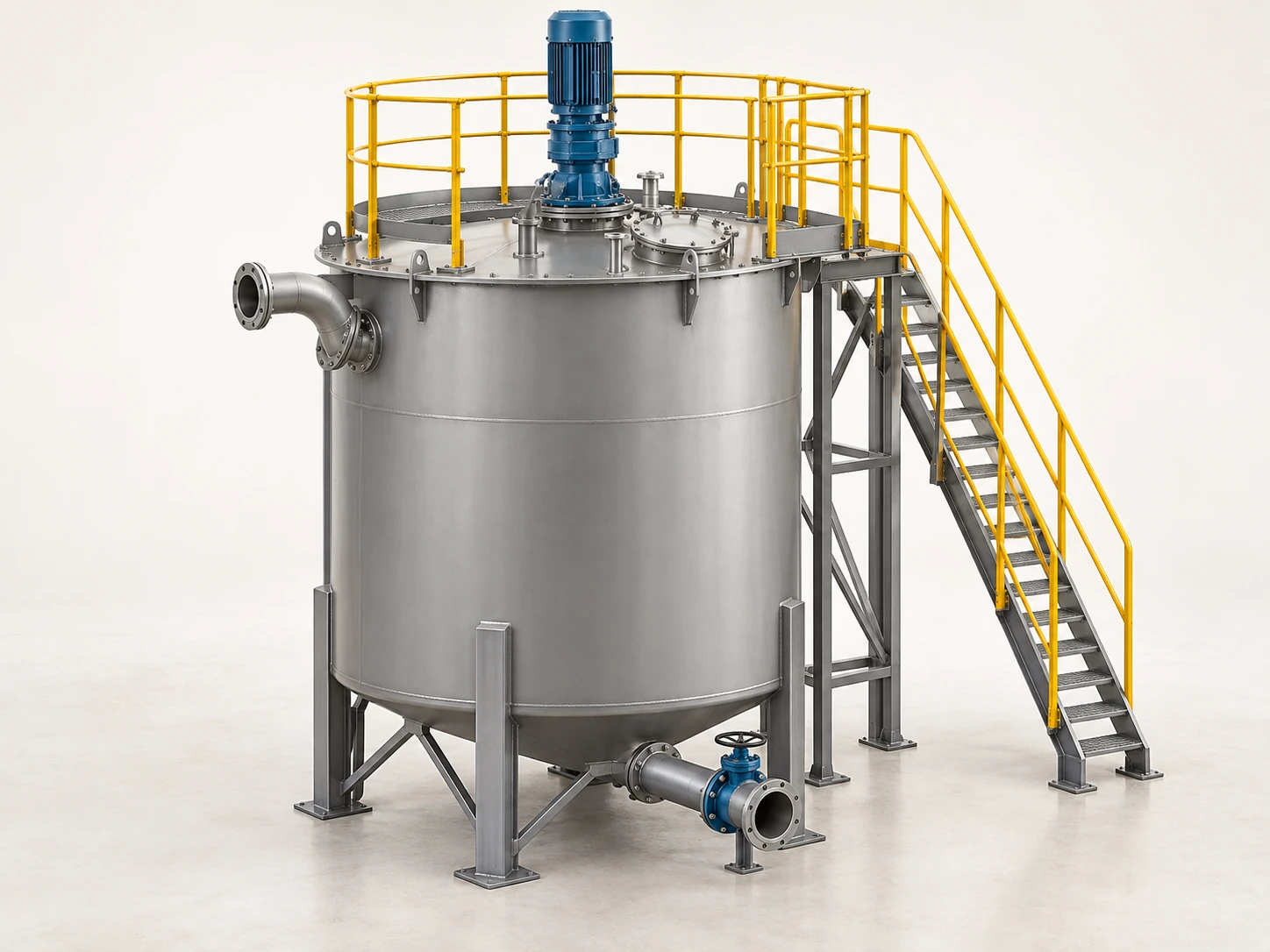
What Maintenance Protects in a CIP or CIL Tank Train
A leach train recovers gold only while every tank keeps its slurry suspended, its carbon in place and its air supply working. Most problems in a small CIP or CIL plant start as a quiet loss rather than a breakdown: an interstage screen that lets fine carbon escape to tailings, a worn impeller that lets solids settle in one corner, or sanded launders that send slurry around a tank instead of through it. Each one lowers recovery for weeks before anyone sees it in the gold produced.
Routine maintenance therefore has three jobs. It keeps the agitators and screens doing their duty every shift. It finds wear in the lining, impellers and air lines before they fail. And it produces records, so that a fall in recovery can be traced to a cause instead of being blamed on the ore. The interval table further down this page lists the routine checks; the sections below explain how to run a planned internal inspection and what to watch between shutdowns. For the wider process, see the CIL and CIP plant guide.
How to Run a Planned Leach Tank Inspection
An internal inspection means taking one tank out of the train, emptying it and sending people inside. That combines a confined space, residual process chemicals and heavy rotating equipment, so it must follow the plant’s written safety procedures and permits. The sequence below shows the order of work a plant manager should plan around; it does not replace those procedures or the chemical handling rules set by your process designer.
- Plan the bypass. Decide how slurry will flow around the tank while it is out of service, and how the carbon it holds will be moved to the next tank so it is not lost or left unaccounted for.
- Isolate the energy. Lock out the agitator drive, air supply and any pumps, and record who holds each lock.
- Empty and wash down. Drain the slurry to an approved destination and wash the tank according to the decontamination procedure, so no settled residue remains on the floor.
- Test the atmosphere. A competent person tests the air inside before anyone enters and keeps monitoring during the work, using a gas detector fitted with the sensors your procedure specifies, including one for hydrogen cyanide where the process requires it.
- Inspect and record. Check each item in the list below, photograph or sketch defects, and measure wear where possible so the next inspection can compare results.
- Repair, then return to service. Replace worn parts, repair lining damage and allow any coating to cure as the manufacturer requires. Restart the agitator before filling the tank fully with slurry, then confirm suspension and screen flow over the first shift.
Inside the tank, the inspection should cover:
- Impeller blades and the shaft, for wear, cracking and loss of balance.
- The lining at the slurry line and around the floor, where abrasion and corrosion concentrate.
- The interstage screen mesh and its seals, for holes or gaps that would let carbon pass.
- Air sparging pipes and nozzles, for blockage or breakage.
- Baffles, the tank floor and the inlet and outlet launders, for sanding, cracks and leaks.
Plan the shutdown when the tank train can spare one tank, and keep spare impellers, screen mesh and lining repair materials on site beforehand. A tank that waits two weeks for a part keeps the whole train running short.
Early Warning Signs Between Shutdowns
Operators see most developing problems before an inspection does, provided they know what to look for. The table connects common signs to their usual causes and the first action to take. Treat it as a starting point for fault-finding: when a sign persists, confirm the cause with the plant metallurgist or the equipment supplier.
| What the operator sees | Likely cause | First action |
|---|---|---|
| Fine carbon in the tailings sample or on the tailings screen | Torn interstage screen or worn seal | Check the screen on that tank and the carbon inventory; repair before carbon losses grow |
| Slurry level rising behind one screen | Screen blinding with grit, wood chips or oversize carbon | Clean or rotate the screen and check upstream trash screening |
| Agitator noise or vibration has changed | Impeller wear, loose blades, bearing or gearbox wear | Check gearbox oil and bearings; plan an impeller inspection |
| Coarse sand in launders or a dead zone on the tank surface | Weak suspension, often from impeller wear or a slurry that is too dense | Check impeller condition and slurry density against the design |
| Rust staining or seepage on the outer wall | Lining failure inside the tank | Mark the area, monitor it and bring the internal inspection forward |
| Lower dissolved oxygen readings at the same air flow | Blocked or broken air spargers | Inspect the air lines and valves at the next opportunity |
The common thread is recording. A daily log of agitator condition, screen checks and carbon movements lets the plant compare this month with last month and act on a trend rather than a single reading. For a first estimate of tank volume, use our leach tank calculator. If you are sizing new tanks or replacing a worn train, send us your tonnage, slurry density and leach test results so the tank volume, agitators and screens can be specified together.
Gold Leaching Tank (Agitation Tank) Specifications
The figures below describe typical industry specifications for this class of equipment rather than a single fixed model. Use them to scope a requirement, then confirm exact figures against the supplied unit before purchase.
| Specification | Typical value |
|---|---|
| Working volume per tank | 10–200 m³ for small plants |
| Tank diameter × height | About 3×3.5 m to 7×7.5 m |
| Tanks per train | 5–8 in series |
| Agitator power | 3–30 kW, per tank size and slurry density |
| Impeller | Hydrofoil or pitched blade, rubber lined or hardened |
| Slurry density | 40–50% solids by mass |
| Construction | Carbon steel, epoxy or rubber lined; bolted or welded |
| Interstage screen | Mechanical swept or airlift, 0.6–0.8 mm aperture |
| Aeration | Air or oxygen sparged, 6–10 ppm dissolved oxygen |
| Flow between tanks | Gravity overflow via launders, 200–400 mm step per tank |
| Power supply | 400 V 3-phase 50 Hz |
| Transport | Bolted panel tanks ship flat in containers |
Gold Leaching Tank (Agitation Tank): Uses and Applications
- Carbon-in-leach and carbon-in-pulp gold circuits
- Regrinding and leaching old amalgamation tailings
- Upgrading a vat leach site to agitated leaching
- Cyanide detoxification tanks at the end of the circuit
Maintenance Schedule
Most premature failures in this equipment class trace back to a missed routine check rather than a design fault. The intervals below are a practical starting schedule; adjust them to your duty cycle and the manufacturer manual.
| Interval | Task |
|---|---|
| Every shift | Confirm every agitator is running and slurry is fully suspended; check interstage screens are flowing and not overflowing carbon. |
| Weekly | Clean or rotate interstage screens; check gearbox oil and agitator noise and vibration; inspect launders for sanding. |
| Monthly | Inspect impeller wear and shaft alignment; check lining at the slurry line and tank bottom where accessible. |
| Quarterly | Inspect air sparging lines and valves; survey tank walls and floor for corrosion or leaks. |
| Annually | Drain and inspect internals; repair lining and replace impellers and screen mesh as needed. |
Frequently Asked Questions
What size leaching tank do I need?
Tank volume comes from your daily tonnage, slurry density and the residence time your ore needs, then split across the number of tanks. As a worked assumption, 50 tonnes per day at 45% solids by mass, ore density 2.7 t/m³, water density 1 t/m³ and 24 hours residence needs about 79.6 m³ of working volume. Adding 10% of that volume for planning gives about 87.6 m³ total, or six tanks of about 14.6 m³; confirm actual freeboard and geometry in the design. Leach test work on your ore sets the residence time.
What happens if the agitator stops?
The solids settle to the tank floor within minutes and can pack hard enough that the agitator cannot restart under load. Plants need standby power or a restart procedure, and tanks should not sit settled for long. This is one reason generator sizing matters on off-grid sites.
Should tanks be bolted or welded?
For remote Tanzanian sites, bolted panel tanks are often the better choice because they ship flat in containers and are assembled on site. Welded tanks need fabrication on site or oversized road transport. Both work if the lining and sealing are done properly.
Can I use leaching tanks with an existing vat leach site?
Yes. Operators commonly add a regrind mill and a short tank train to treat material that vats leach poorly. The fine gold locked in particles only dissolves after grinding, which is why agitated leaching often recovers gold that vats leave behind.
Supply and Delivery Across Tanzania
Bart Mining supplies gold leaching tank (agitation tank) and related equipment to mining operations throughout Tanzania, with primary coverage of the Lake Victoria Goldfields (Mwanza, Kahama, Geita, Shinyanga and Bukombe), alongside the Lupa Goldfields around Chunya and Mbeya, and delivery nationwide from Dar es Salaam.
Commonly supplied to: Chunya, Mpanda.
Manufacturer or supplier of this equipment? Bart Mining sells machinery like the gold leaching tank (agitation tank) to buyers across Tanzania through its local market partnership.